Showing posts with label Pain. Show all posts

Sunday, November 18, 2007

Pain For Dummies - Part X

or: The End (?)

Over the past few weeks I've tried to explain a few things about pain, you and your brain - and why science is important and how it helps us to understand ourselves.

I will of course continue to post about these topics - but the Pain for Dummies Series comes to an end with this posting.

To sum up the series:

Pain is incredibly complex - it involves the whole brain, it can (and must) be tackled using different approaches (hence biopsychosocial). And we are far from understanding it completely.

Most important however is the fact that there is such a thing as a "brain in pain" - a brain that has learned that there is pain to be expected regardless of what the person does - and that you can re-learn to be pain free!

That doesn't happen overnight of course - you'll need lots of patience - but there is a basic entry level for everyone. Find it and start (re)training - now!

Here's what I covered over the past few weeks:

Part I: What is Pain?, Pain and the Stress Response

Part II: The Multidimensionality of Pain and the Biopsychosocial Model

Part III: The Psychology of Pain

Part IV: Metacognition - the coolest feature you have and didn't know about

Part V: The social aspects of pain

Part VI: Can you handle the truth?

Part VII: What’s this new approach all about?

Part VIII: Practice what you preach!

Part IX: What’s the economy got to do with pain?

I hope that you can use some of the tips and tricks I put into my postings and that they will make your life easier - or better yet point you towards a pain-free future.

Coming up are a few postings about how we can tackle chronic pain from a therapeutic point of view - by exercising the virtual body and giving non-nociceptive feedback for example.

Stay tuned!

End of Days

Thursday, November 8, 2007

Pain for Dummies – Part IX

Or: what’s the economy got to do with pain?

Economics is a difficult field to study. Making accurate predictions is hard because human behaviour and decision making are so erratic it’s beyond belief. The emerging field of neuroeconomics is trying to rectify that situation by looking at the brain during decision making processes. Some of the findings are really scary – people prefer short term gain over long term gain for example. Doesn’t bode well for things like working on issues like climate change.

But this blog is about pain – your pain – so how does economics help us deal with it?
I’ve written about the positive effects of work on pain by providing a source of distraction.
But what I want to explore now is one of the basic premises of the science of economics: people react to external factors (without necessarily being aware of them) .
Or: your environment influences your behavior – much more than you know.

Consider my own example: I like to move. I like to exercise. But for the past few years my external environment "didn't let me". There simply was no incentive for me to take care of my own body. I knew that I should've been doing something - but was literally unable to follow my own advice. ;-)
After changing jobs and the place where I live the situation improved dramatically and now "I'm back"!

Even more dramatic are some of the experiments of the 60’s in social psychology:
Zimbardo and Milgram took well adjusted people and put them in difficult situations – Zimbardo used a made up prison environment and Milgram used an authority figure – and look what happened.
Experiments like this show that everyone of us has a range of possible behaviors within him or her – if they are triggered depends on the circumstances we encounter in life.

It’s like the old debate over nature and nurture. Some out there – adherents of the black and white world view still talk about nature vs. nurture. But that’s nonsense: it’s genes and how the environment acts to activate them. If you have a genetic disposition to be afraid of water and you live in the desert those genes are never activated. It’s the combination that determines what happens.

The same with you and your pain: if you are more likely to develop chronic pain due to a genetic disadvantage you have to work on the “nurture” part – that is your environment to reduce the impact. You can’t change your genes – yet – but you can try to lower the chance of those genes being expressed (the fancy way of saying “activated”).
Work on developing helpful coping strategies for example – the pain itself doesn’t necessarily go away – but the impact it has on your life is greatly reduced. Work on distracting yourself – don’t let the pain rule your life.

If you are prone to develop stress related diseases – again: coping, relaxation and distraction are key. But here is where it gets interesting:
“de-stress” your environment – i.e. your surroundings at work and at home.
Peripheral vision works by checking your surroundings for (sudden) movement and drawing your attention towards it; it is one of the systems we have that helps to protect us from dangerous predators – sabre tooth tigers and the like. Since those aren’t around anymore it now reacts to everything that moves – decidedly unhelpful in our modern world.
If your desk or workspace is too open to such intrusions – close it of. Walls are there for a reason!

The same applies to your desk itself: to much clutter is unhelpful – “visual clutter” is enormously distracting. Your brain scans all the items lying around and uses up a lot of energy doing that. That’s why we have bookshelves, cabinets and the like at home – when everything is in it’s place the atmosphere is a lot more relaxed.

Use indirect lighting to create “mood”. Direct light is very harsh – indirect lighting creates softer light which most people find pleasing. Color is another great way to “de-stress” your surroundings. You can choose warm (yellow, red) or cold ones (blue).

Gentle Thoughts

One of my favorites is smells: they are very powerful since they are directly channeled into the brain – not having to go through several processing steps like the other senses. It all depends on what you like – but give it a try and find something that’s just right for you.
Same with music – that’s why there are songs for driving, working out, … – the rhythms are able to influence your heart rate.

There are of course things you simply can’t change – but try to find workarounds wherever possible. Know your strengths and build on them – manage your weaknesses.
Use Metacognition to identify which things, objects and situations in your daily life cause problems and work on changing their impact.

Sunday, November 4, 2007

Pain for Dummies – Part VIII

or: I'll be back!
or: practice what you preach!
or: change in action!

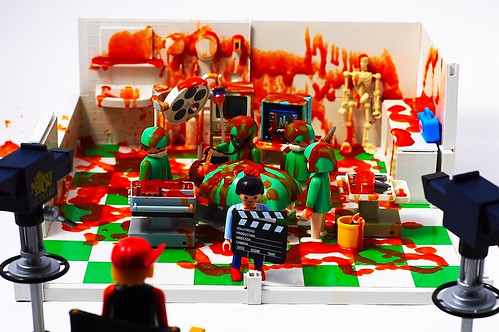
Headshot


Yes folks - I did what I always said I would: I started working out again.

There was no doubt in my mind whatsoever that I would start doing some form of workout again - I just had to find the right time and the right circumstances. That's what I call the economics of change - but that's the topic of another posting.

And - having paused for quite some time - it feels so good to physically exhaust oneself again.

You guessed right - I didn't take the slow methodical approach - I'm more along the lines of Jeremy Clarkson yelling "Power" when I start and "More Power" when something isn't going according to plan. ;-)

The biggest difficulty in starting an exercise program (or any other training regimen) is always the (felt) lack of time.

And while everyone knows that's not really the problem it is the most frequent reason people give when asked why they don't do regular exercise.

For me - as always - the problem can be tackled from a neuroscientific point of view - that's why the title of the blog is "The Neurotopian"; I envision a future in which every question can be answered from a neuroscientific basis.

So why don't people have time?

Well - it's the same process that's at work when it comes to visual perception - it's called filling-in.

Our eyes have a region called the blind spot - it's where the optical nerve leaves the eyes. There are no receptors there - so we have a big hole in our field of vision. You can test your blind spot and even map the size of it - here.

Curiously enough we don't notice it at all in normal life.

The brain employs a mechanism known as "filling-in" where it "calculates/estimates" what should be in that blind spot and fills in the missing information.

The same goes for touch, for hearing and all the other senses we have. If something is not there the brain doesn't leave a hole but presents us with a complete and whole picture.

Now try this experiment:

take a normal workweek - 24 hours and 7 days and try to remember what you did during that time.

Notice the times you slept, ate, drove to work, ...

Finally - try to remember the times when you did absolutely nothing! Nothing except breathing and staring at the wall waiting for the clock hands to move forward an hour.

I bet you can't find any such time.

Even "doing nothing" involves doing something - even something completely meaningless.

And those are exactly the times you have to identify. There is your ideal workout time!

For me it was coming home on Tuesday evenings at 8pm and just checking emails, looking through Flickr, reading a few blog entries and similar stuff - nothing really groundbreaking. But it became a habit.

Till I realized that none of it was really useful - I could do the same a day later too and have enough time to exercise for a full hour.

Surprise surprise - it worked perfectly. Even better than that - by exercising somehow time afterwards seemed to move more slowly - maybe all those endorphins kicking in - and I still had time to check my email and read a bit.

The problem like I said is not that there is no time - but time that is simply filled with something - anything.

Find it - use it.

Thursday, November 1, 2007

Pain for Dummies – Part VII

Or: what’s this new approach all about?

As described in the previous posting the old paradigm – the body based approach - is still alive and used widely.
The new one is radically different – so much in fact that it seems strange and too simple.
How to explain it so that everyone can understand and benefit from it?

A good starting place are these two great books: Phantoms in the Brain and The Body Has A Mind Of Its Own. They are able to give a much more in-depth view of what it means to have a brain. ;-)

In short: imagine yourself having to drive from say Paris to Berlin. In order to prepare yourself for the journey and to be able to estimate the resources you need (time, food, gas,…) you use a map. The map isn’t the territory – it would have to be on the scale of 1:1 to do that – but it is a representation of the actual landscape you are going to be traveling through.

You Decide

With the help of this map you can easily measure distances which – combined with speed – give you a rough approximation of how long the journey is going to take. You can check for elevations, roads, highways, restaurants and so on. You are able to plan the journey – including rest stops and a whole lot more solely based on the representation you have lying before you.

Maps are so great in fact that our brains have discovered them millions of years ago. Even better – we not only have one map but hundreds of them – each for one specific function.
Maps of the body are so old that they are hardwired into the genetic structure of our brains – meaning that even when you are born with a missing limb the map for it is still there in your brain.

The modular structure of our brains is laid down very early during development – congenitally blind people (blind from birth) still have a visual cortex and so on.

Maps are so useful because they enable us to react lightning fast; if your brain had to check if there really are two legs when you slip you’d have fallen to the ground before you could react. With a map in place everything is sped up and you are able to recover balance. Most of the time anyway. ;-)

The old paradigm focused on the terrain itself – in CRPS for example treatments were aimed at restoring circulation to the injured limb. What neuroscience has found is that instead the arm being the cause – it’s actually the hand representation (the hand map) that is the cause of the changes we can see.

Other – so called higher centers of the brain – then act on that distorted information; no wonder that the output they produce isn’t the right one – they simply don’t "know" better. The brain is acting on distorted information.

Treatment has to focus on the cause: re-modeling the hand representation as fast as possible.
Fortunately these maps are plastic – that means they have the ability to change. That’s how we are able to learn and acquire new skills – if we learn to ride a bike for example those new motor patterns become hardwired into the structure of our brains. In the case of chronic pain that whole process of learning goes haywire – there is such a thing as too much of a good thing.

Re-training or re-modeling can take different forms – depending on where your individual starting point is: if really all movement with the affected limb is painful then start with motor imagery, i.e. imagining moving the limb. Motor imagery is very effective as a stand alone treatment since it activates the same neural circuits in your brain that you use to do the actual movement. All that’s missing is the motor command that tells you muscles to contract.

After this first step you can start actually doing the movement with a mirror box – the affected side behind the mirror so that your brain is fooled into thinking that the limb it can see is doing what it wants.

You create a congruence of motor intent, motor output and feedback that way.
Gradually the map is remodeled and function returns.

As Harris points out it’s enough for pain to occur when the brain is unable to make sense of divergent information – so pain should subside very quickly when you do the few first sessions – only to return a short while afterwards.
Don’t despair – it just shows that your brain is still able to turn of the pain and willing to learn.

At least this should give you the hope and motivation one so desperately needs when so else has failed.
And the best thing: it’s easy to do.

One can only hope that these new findings spread as fast as possible since even some of the most serious illnesses out there – think anorexia with a 20% death rate – most probably have their origin in these body map disorders.
Reestablishing those maps can alleviate symptoms very quickly and help save thousands of people from suffering.
Spread the word!

Thursday, October 18, 2007

Pain for Dummies – Part VI

Or: can you handle the truth? ;-)

Motivational Speaker

When taking the history of a patient one phrase comes up all too frequently: “I have tried everything”.
To be honest: no – you haven’t.

Here’s why:
We – and this concerns all of mankind – have a huge problem: there is so much information available that we have a hard time keeping up. Add to that that not only would you have to read all this new information – but also understand it and use it – while also working your usual 40 hour+ work weeks.

Change is hard – as explained here. Old patterns – be they motor patterns or other behaviors – are more efficient than new ones. That’s why - especially in times of stress - we use them over the new ones.

The treatments you as a health care professional provide are on the safe side – something you have established over the years. You think you know that they work and you apply them over and over again.
Problem is that they are mostly based on what I call the old paradigm – the purely body based approach (structural thinking).

You have to remember that the brain was out of reach of serious scientific study until 10-15 years ago. People in pain could describe their problem – you could look for clues what’s wrong with their body – but there was no way to have a look at their brain in pain. That’s why treatments for tinnitus, phantom limb pain, fibromyalgia, CRPS and other similar ailments focused on the changes that were visible to the naked eye so to speak.

That’s why – when you look at the studies done using those kinds of treatments you always end up with the “rule of thirds” as I call it – a third of the patients got better, another third stayed the same and the rest got worse.
It's like using a shotgun: some pellets hit the bad guy - the rest misses or injures an innocent bystander. In medicine you prefer the magic bullet that is able to hit the problem directly - nothing more - nothing less.

It’s no ones fault really: there simply was nothing better at the time.

This however has changed rapidly during the “Decade of the Brain” – now we have treatments that are able to address the cause of the problem. And here we encounter the second obstacle on our way forward: health care professionals have applied those old treatments for years – with moderate success (think shotgun). But since those illnesses were so hard to treat even 30% improvement seem like a good deal. Those old treatments are “hardware” based – flashing lights, infusions, pills, … - they all seem very thought out.

They are – there really is no other way of describing it – “sexy”. They are what you – the average Joe – came to expect from medical professionals (in a future posting I'll write at length about the link between expectancies and experience).

Along come the neurosciences and take away all the fun by having you use a mirror.
And even I have to admit: it just sounds too simple. Moving both hands while looking into a mirror? – you dare call that a treatment? Are you nuts?
Even worse – you – the health care professional – doesn’t have to do anything but explain what to do?
Remind me why I should pay you for just talking to me?
The next guy is even worse – telling me not to move anything but just think about it!
Has everybody gone crazy?

Now imagine having to explain this type of treatment to others in your field – can you imagine how a hands-on trained physiotherapist is going to react?
Asking someone to change their whole approach of thinking about a medical problem and changing his treatment methods accordingly isn't a step taken lightly.

And then there is the word “psychological”.
I treated a MD once who himself suffered from phantom limb pain. When I asked him about mirror training he said that he read an article about it once but never tried it because it was published in a Psychology journal.
If you can’t convince people like these – imagine how long it’ll take till a new generation of health care professionals is in the majority and the “new” treatments become universally accepted.

As for you – the patient: what can we learn from this.
a) Again: no - you haven’t tried everything because the people treating you aren’t aware of every option available.
b) the Internet comes to the rescue: information is free – you can read the articles yourself; the better educated you are about your problem the better you can help yourself
c) forget “the media” – they have the “empty space” problem, i.e. they have to fill 24 hours of programming and the pages of their magazines and are very unreliable sources of information. They are clutching at straws –producing huge amounts of "Fark" - hyping everything; pain is serious business – it doesn’t need the latest trend – but good science.

Sunday, October 7, 2007

Pain For Dummies - Part V

The social aspects of pain.

Humans are social animals through and through. Our brains are hardwired to enable us to live in groups of up to 150 people - what others sometimes call a tribe.
Nowadays with over 6 billion people around we have to be more open and willing to meet and interact with others - but our peer groups (those that are close to us) - remain relatively small.

How do children learn to speak a language? How do they learn how to eat with tools? Where do they get their behavioral norms from?
At first from their parents - since they are there 24/7. They observe behavior, speech patterns, motor patterns and simply try to do the same.
As they grow older other people come into their lives - and they adapt to those as well. As social animals we want to be able to fit in and communicate with others - so we have to find a way to connect with them.

That's why babies and children have no problems learning several different languages at once - the need to connect and their ability to learn is nearly limitless.

What about pain?
First we have to distinguish between the subjective experience of pain which isn't visible and the outward expression of someone in pain. It has been suggested that the basic pain threshold is pretty much the same in every person (apart from "redheads" who are more sensitive).

The most striking difference however occurs in how people of different cultures express their pain - how they show the world around them that they are in pain. Remember - this is also a learned response! But if you are from a different culture that has it's emphasis on let's call it "quiet suffering" - you might be overwhelmed when someone shows up who is very agitated although he has only a minor injury.

That's why it's so essential to have some kind of objective measurement. I had a patient once who - despite rapid improvement in function - still complained about the pain in the most exaggerated fashion. Even tests that are meant to provoke the pain were negative - but asking him about how he felt got me the same response every time. Since in his case there was only acute trauma and pain I felt very confident that his description was something cultural and no longer something physical.

We should also be aware that the behavior we see in people is sometimes a reflection of what the medical community has "done" to them. Imagine someone in chronic pain who keeps on going - someone with a positive and life-affirming attitude.
Now put that person through a medical journey from hell - no one takes him seriously, no one listens time to listen and so on and so forth.
One simple response to such treatment is to start to exaggerate the outwardly visible part of the pain experience!

If people don't pay attention - you have to do something to change that; small children are masters at this - they use their acting skills to the fullest and without holding back.
Just watch them when they feel they don't get the attention they deserve - suddenly they start limping, develop "stomach pain", .... - they learn that by faking symptoms they can get what they want!

I'm not saying that these responses are intentional - they are learned and become automated - like the rest of our behaviors. In principle they work like a simple reflex - if you get the desired outcome the behavior is reinforced.

But as we have seen before we have this thing called metacognition and can become aware of these behaviors and change them.

The lesson for therapists is this: if you see exaggerated illness behavior (that's the technical term) - listen, educate and be a honest health care practitioner. These people don't need another snake oil salesman.

Is there a message for patients as well?
To be honest - I don't know yet. As soon as I come up with something for you to work with I'll let you know.

Hollywood also uses exaggeration as a tool: ;-)

Quarantino

Wednesday, October 3, 2007

Pain For Dummies - Part IV

Metacognition - the coolest feature you have and didn't know about.

Let's face it - changing one's habits isn't easy.
Just watch smokers who unsuccessfully try to give it up.
Our brains are prediction machines - they use experience and other stored information (motor patterns) to get us through the day.
That's why we are able to identify people by the sound alone that they make when they walk - because they always walk that way (the same motor pattern is used over and over again).

Using established motor patterns and habits makes sense because it doesn't require any attention and is therefore a very efficient process - as long as things go according to plan.

It is also very quick - so that you are able to regain your balance very quickly after you slip. If you had to do something like that consciously you would start sending signals to your muscles only after you were already lying on the floor. It's incredible to see just how slow our brains get when the cognitive demand is even just upped a little: see these kind of tests/games for example.

The message is this: learning/re-learning requires time and a non-threatening/not-distracting environment. If you want to learn something new your brain has to be convinced not to use the fast and efficient old pattern - but the slow, inefficient new one.

Try this simple little experiment at home: brush your teeth with your other hand tonight. Sounds simple enough - right?
After you've done this think about people who have to learn to walk again after a stroke and maybe you'll be able to understand what they have to achieve.
I'd rather climb Mt. Everest than ever having to do that!

This far we have only talked about motor patterns - but what about habits?
Well - it's all just electric signals - so we can treat them the same - the brain does so too.

Thoughts - those that are automatic - are the same as motor patterns. They just aren't visible to an outsider. They are also stereotypical - based on experiences and memories. If you express them outwardly they are mostly called "prejudice".

Think about it: our brains form categories for everything around us - they have to in order to be fast enough. When you look at a picture like this your brain doesn't really "look" at it but simply calls up the appropriate categories (toys, Playmobil, bath, ...) and constructs the visual experience you have.
And it has no problem making huge mistakes doing this. That's why 99% of people fail to notice that the Playmobil figure has a frowny face!

And that's why we are prejudiced: experiences we have with only one person with a "special" characteristic are applied to the whole category that person belongs to!
"All Men are the same" is just one of those things we say and hear all the time.
But the same goes for skin colors, professions, weight, height - every observable difference to oneself really.

Where does chronic pain fit into all this?
Pain is in your brain - it has to be. And we know from research that people who suffer from chronic pain react automatically with a stress response when they just read words that are associated with pain! This alone can lead to an increase in their pain!
Do they know this - are they aware of it? No.
It's an automated learned response that is outside of conscious awareness.

But - and this is where the cool feature of Metacognition comes in - you can learn to become aware of this automatic reaction if you choose too.

Metacognition means "thinking about thinking" and is the same as watching yourself walk in front of a mirror. You observe an automated motor pattern/habit - thereby creating feedback that you can use to change the pattern.

Let's say you don't like dogs - your automatic thought is something like "He is jumping up and down because he is going to bite me in the leg."
Changing this reaction requires you to become aware of it - just "stand back" and watch what your brain and your body does when you see a dog. Heart rate? Pulse? Breathing? Muscle tension?, ... - just observe these reactions.

That's the first step you have to master: you have to notice all those little things - especially the rise in muscle tension in stressful situations. You have to become aware of the position of your shoulders in order to be able to change it later on.

And just to give you a rough idea of how long this first step takes: it'll be well into 2008 - still 3 months away at this point - before you are any good at it. Think weeks and months instead of days. That's why "old habits die hard".

The good point is that even a little experience is better than nothing and you can start improving the situation right away.

The second step is to actively stop the automated reaction. As soon as you start thinking "He is going to bite me!" - interfere.
Rationally observe the situation, look at the real facts - not the ones your brain is pumping out - and act on it. The best way to do this is to find someone who has a dog and explains their body language to you. Interact with one (a friendly one of course) and simply get to know them.
I did this myself a few years ago and am no longer afraid of them because I can tell from the way they move that they are mostly just curious about who you are and want some attention.

Again - when it comes to chronic pain - stop those automatic reactions.
Since the stress response is the easiest to feel and observe it's a good starting point - that's why relaxation techniques often bring fast relief. Like taking a bath:
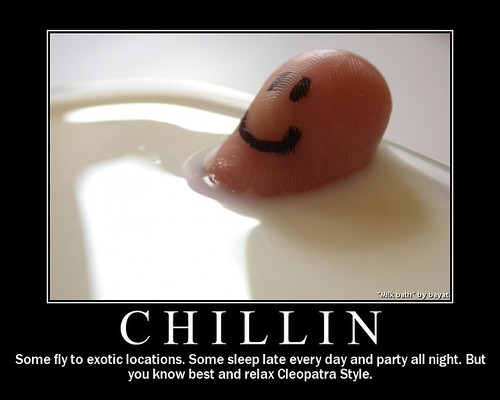
Chillin

The other things like thinking "This is going to hurt" when you perform a movement are a little harder to change - but it's not impossible.
Take your time doing them, don't do too much at once (pacing) and gradually expose yourself more and more in order to adapt. Sleep on it in order to establish new patterns.

By the way: in Psychology this form of therapy is called Cognitive behavioral therapy - and it is extremely effective.

Pain For Dummies - Part III

The Psychology of Pain.

This is a big one - probably the most important factor contributing to the development and treatment of chronic pain.

First let me get one thing out of the way: there is a link between chronic pain and psychological problems (depression, ...) - which means that yes - pain is (only) in your mind/brain.
But - and this is good news: we still can't tell for sure which comes first!

Imagine yourself having to live with chronic pain day in and day out. Going from doctor to doctor - spending a lot of time and money on treatments that don't work - loosing friends, social support, .... - who wouldn't get depressed? It's damn near impossible to stay happy when you hear the stories of people who went through hell for years on end. It's normal to become depressed when there simply is no end in sight to the suffering you have to endure.

What it comes down to is this: there are people who are just better at coping with difficult situations than others - copers vs. non-copers. Some people are just able to handle everything that life throws at them - no matter how horrible we think it is what they have to go through. Think imprisonment (concentration camps), torture, war, accidents where you have to cut of your own arm in order to survive.

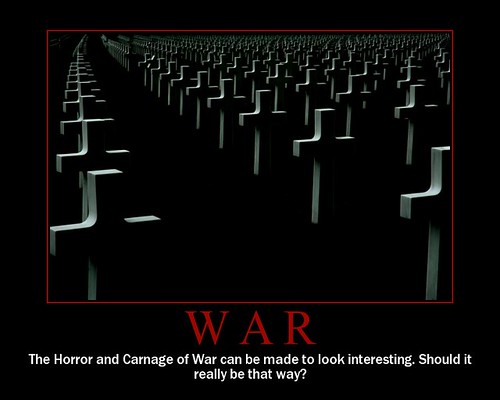
War

Impossible? Definitely not - there are tens of thousands - hundreds of thousands (?) of people who are able to cope with such things. What happens is that just as we have a healing response when it comes to our tissue we also can heal psychologically. Our psyche receives "damage" and goes through the same stages that healing tissue does.

The basis for who is a coper or a non-coper are probably the same as for everything else: it's partly genetic - so choose your grandparents wisely ;-) - and the environment either activates those genes or it doesn't.
Nature and nurture instead of nature vs. nurture.

Let's say you are one of those who was unfortunate enough to have the wrong genetic code and is more likely to be a non-coper/pessimist.
What can you do to improve your situation?

- Distract yourself: attention is a limited resource; if you concentrate on the pain it gets worse - shutting out everything else. Focus your attention on something else and pain is reduced.

- Find an outlet: put a rat in a cage and give it random electric shocks; the rat has a chronic stress response leading to high blood pressure, osteoporosis and ulcers. Give the rat an outlet - something it can bite for example - and nothing happens. If you put a weaker rat in an adjacent cage the rat that gets the shocks runs over and bites the other rat that is just sitting there. Guess who gets the ulcers now?
I think everybody knows these two types of people: the ones who have to jog for miles every day and the others who take out their frustration on their subordinates. I recommend the first way of coping!
And while you are at it buy this book. Trust me. It doesn't get any better than this.

- Write about it. Pennebaker has done some amazing work on this. Expressing emotions helps enormously in dealing with them. I think that this has to do with the way our brains are built - we have two hemispheres that are organized differently. One hemisphere is the "human" part - emotional, creative, ... - the other is the more "robot" like part: pure rationality. There is a bridge between the hemispheres - the corpus callosum - but it can't transmit every bit of information - it's bandwith is limited.
If you use your eyes however - by reading something you just wrote down - the part of the brain that didn't have anything to do with the creation of those words and thoughts gains access to them through a different channel and is able to contribute too.
That's why it's also helpful to take out pen and paper and start drawing sketches when you are stuck working on a concept or a presentation.
Mind Maps also work by using this pathway; as soon as you are able to use all of your brain - and the differing points of view the hemispheres have to offer - the sky is the limit. ;-)

- Do something different. I can't stress this enough: keep learning - forever. Novelty is one of the best ways to distract yourself because learning a new skill - be it a new sport, a new language, a new way to move your body needs a lot of resources. It is estimated that we can only keep our focus for a maximum time of 15 minutes - after that our brains start to get tired.
Compare your sleep quality after a normal day with the quality you have when you solved a new type of puzzle before going to bed.
Our brains use the time we are asleep to consolidate memories and to add to the "experience database". If you give your brain something to do during the night it'll do so happily - leading to deeper and more refreshing sleep.
Yes - you can distract yourself even when you are unconscious!
Problems that seemed unsolvable the day before are often gone the next day; I had that experience a few years ago playing Panzer General: I just couldn't get past the Russian Defences at the battle of Kursk. After dreaming about it (!) I woke up and was easily able to smash a hole into their front line after which my tanks were able to pour through.
Imagine that: achieving victory through sleeping well - not by working harder. ;-)

If you want even more advice on how to become a better coper familiarize yourself with this very exiting branch of psychology: Positive Psychology - initiated mainly by Martin Seligman.

For those to take the test - don't despair - pessimists (like myself) are more prone to depression but at least we are able to see the world "as it really is" - and not through pink-colored glasses. That has it's advantages too.

Sunday, September 23, 2007

Pain For Dummies - Part II

The Multidimensionality of Pain and the Biopsychosocial Model.

With the arrival of brain scanning techniques like fMRI and PET-Scans the Neurosciences really took off. Until a few years ago the brain was still just a black box doing mysterious things and the only clues we got as to it's inner workings was done by observing the output it produced.

That's why there are still some who think that there are pain fibres in the body or specific pain centers in the brain. Anatomy and all the other sciences had nothing else to work with and postulated their findings as the "only truth".

Today we know that pain is a multidimensional problem - it has biological causes and consequences, psychological components and acts itself out in a complex social environment.
It's not longer sufficient to draw a picture of a boy burning his foot and following a line to his brain that represents the pathway the pain travels to be a successful therapist.

In order to be able to treat pain - especially chronic pain conditions - you have to be aware of all the components of the pain experience. The best approach to date to describe this complex interplay of different fields and specialties is the so-called "Biopsychsocial Model" (of Health and Illness).

It postulates that in a lot of situations the pain itself isn't the biggest problem - but the way the person in pain or those around him/her perceive and deal with the pain. This goes all the way from family members who offer too much help to doctors and therapists who don't take the patient seriously and even society as a whole when it comes to things like sick leave and sick pay.

Let's look at some of the parts that make up the pain experience:
The biology is very complex - from nerves to neurotransmitters and even specific genes that make some people more likely to experience (chronic) pain.

These are the stages an acute trauma goes through:
Tissue is damaged - leading to local inflammation to initiate the healing response; the immune system is activated to combat infection, a general and short term stress response is activated to enable us to get away from the pain quickly and to prevent further damage.

In this case - acute pain - nociceptive signals are sent to the spinal cord that modifies these signals according to their importance and sends them up to the brain for further processing. At the spinal cord level reflexes kick in - stereotypical motor patterns to protect the limb or the body.

The brain - based on experience and the circumstances the trauma occurs in decides whether or not to "label" the incoming signals as "pain producing signals". If for instance you are in a serious car accident there are more important things than the abrasions or contusions you have - the brain is more concerned with your survival - hence people after serious injuries don't feel any pain - what we call "shock". The nociceptive signals are all there all right - as are the other responses your body initiated to repair the damage - but no pain - at least initially.

If all goes well the damage is eventually repaired, the stress response is shut of very quickly since it is only useful during the traumatic event itself, nociception stops and the pain goes away.

This short outline is already able to give us a lot of clues as to what and where things can go wrong after we have hurt ourselves. The most important thing however is that the biological part is only one piece of the pain experience. As we have seen it's not enough to have nociception - you need a brain to process that information; and if that brain decides to ignore the peripheral input it can do so. It can also decide to produce pain without nociception.

This is where the biopsychosocial model comes in - it recognizes that pain really is an experience that has different factors that contribute to it.

I think most people can relate to the fact that pain is especially painful after we have done something really really stupid - it hurts more because we are ashamed:

Punishment

Pain For Dummies - Part I

or: what you always wanted to know about pain but were afraid to ask.

What's this pain thing all about then?

Well - acute pain has a lot of useful functions: it is a warning signal that draws our attention towards a damaged area (or to the potential of damage occurring in the future). It enables our brain to react even before we become aware of it. It protects us from doing more damage, and signals - by way of muscular action - other people that we have a problem in a specific part of our bodies (just think of the way you hold your arm when it hurts).

It also interferes with cognitive processes by altering Emotions and Mood - which is another way that other people can tell that there is something "wrong" with us. What good is pain if you can't communicate it to the world around you?

Some used to think that there is a pain center in the brain. But all the brain imaging studies done over the past 10 or more years show a different picture: pain processing centers are everywhere. Pain is a so-called multidimensional sensation - it's the unique combination of effects it has that makes it so powerful.
It invades every aspect of life - and vanishes just as quickly when the danger is gone.

The most dramatic way to show how important pain is in everyday life is in people who are born without the ability to feel pain (congenital insensitivity to pain); it is a very rare disorder - but with very dramatic effects. If one of their bones is broken they still use it as if it were alright - leading to more and more damage and life threatening infections.

The best definition so far is the one provided by the IASP:
"An unpleasant sensory and emotional experience associated with actual or potential tissue damage, or described in terms of such damage."

Notice the "described in terms of such damage" - that's my favorite part. Think about a visit to the dentists office; for a lot of people there doesn't have to be pain in order to feel it. The smell, the sounds, the faces of others in the waiting area and the (bad) memories one has about previous visits is enough to elicit a stress response - and lead to "imaginary" pain.

There are two important lessons here:
1) our brains are pattern seeking and prediction making machines
and
2) the link between stress and pain

1) our brains start looking for patterns the moment we are born. Babies will smile at anything that resembles a face - even a piece of cardboard with two eyes and a mouth. Our brains are hardwired to look for faces especially - that's why we are able to see them anywhere - in clouds, in trees, ...
That's why highkey portraits work so well - they reduce a (human) face to the most basic structures our brains seek - eyes, a mouth and a bit of skull outlined.

Windows To The Soul

So if you brought your brain with you to the dentist it starts analyzing the situation: the smell of antiseptic, the high-pitched sounds of the drill, the facemask (very uncool and unintentionally threatening) - and perhaps bad memories from past visits.

How can your brain not see a pattern that says: "Beware - Pain ahead!". It has to do this - it's hardwired to protect you.
The same goes for every other painful experience you ever had - if your brain recognizes a similar pattern it will make you uncomfortable in advance of the actual experience. It prepares you for action.

2) The "stress response". How does your brain prepare you for such a situation when you are - based on the brains prediction - likely to experience pain?:
by up-regulating your natural stress response - changing the heart rate, shutting down digestion, pumping adrenaline into the bloodstream, ... - all the reactions your body needs in order to flee and or to survive.

You have to remember that our brains developed over several hundred million years - so they still expect sabre-tooth tigers to jump at us from behind mailboxes - not dentists who want to help you. Our brains have learned that overreacting is better than the other way round and essential for survival.

So today any stressful situation leads to the full array of stress responses.
And this is the simple link between stress and pain. Stress makes you more likely to experience pain - and as such relaxation techniques are helpful - they remove part of the pain experience which can make pain easier to live with.
Actually short term stress reduces pain (think the "shock" after a traumatic event) - but long term stress heightens it.

In the next posting we will look at the multidimensional nature of pain.